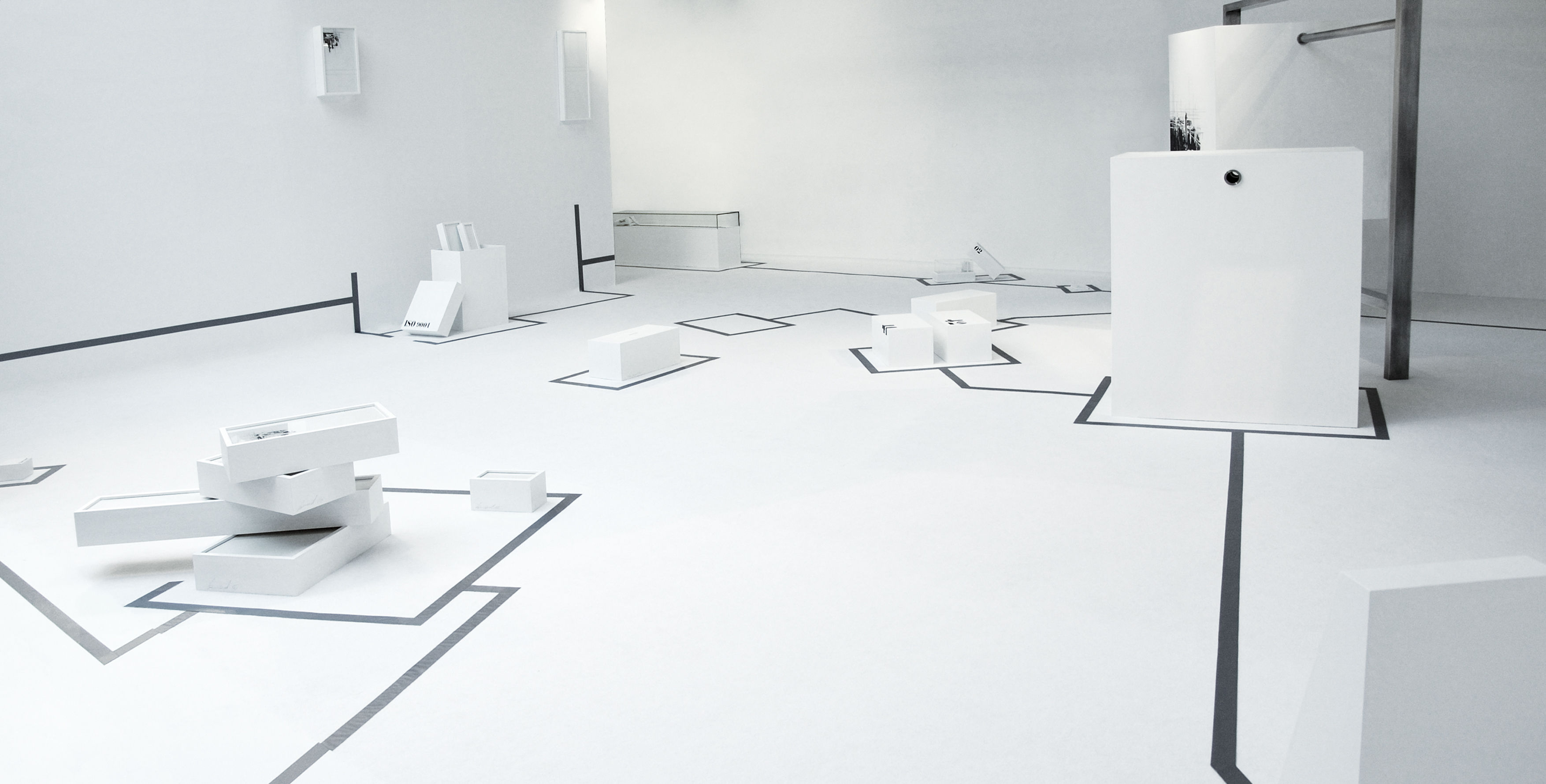
Laumond à l'espace Commines
Running at full tilt, Laumond leads us within a kaleidoscopic vision of the world. A vision that is simultaneously complex, humanist and humorous, global and fragmented, paradoxical. His universe, where the color white dominates, is an invitation to inwardness. At each event, he confirms powerful progress, details his immaculate universe and announces the next steps in the service of inner proliferation.
The content hidden behind his narrative boxes, interlocking volumes, puzzle-like constructions, is dense. These are small parables; they balance and demonstrate the equivalent value of small and large, strong and weak, positive and negative, male and female, the chromosomes of perfection and imperfection, time, space... In his "boxes", the balance between hierarchical values or positions is fragile, but preserved: balance, because how can it be judged and weighed? Fragile, because all of this comes down to so little… Its humanism emerges slowly, almost without his knowledge...
In keeping with Fischli and Weiss and their small sculptures exhibited recently at the Tate Modern, he provides us with visual interrogations on everything that surrounds us, the art world, its references and the end of painting, the artists and movements that preceded him, Duchamp, Fontana, but as a subtle and fertile analyst, he provides his visual and formal response, his vision, his kaleidoscopic interplay and an aesthetics based on perfection.
His large volumes recount the history of our society, its artificial markers and guideposts that he decomposes and recomposes in a joyful fresco. He distorts the appropriation of a name, that of the artist, of a mark, a color, and other external attributes from which he extracts meaning in order to show its limits.
His formal conception of art is completely singular, like that of his writing. A language of symbols, consistent, rigorous and codified, extremely precise elaboration and construction, his work has a remarkable solidity.
Remarkable in both senses of the word: first through its uniqueness. This is pure Laumond, recognizable among all, never borrowing, just patiently constructed with the force of intense diligence and searching, and secondly remarkable through the precision and high quality of his craftsmanship. He seems to have retained in the creation of his works the respect for his elders and the patience of flawless elaboration without concessions. Everything is made to last.
A box – a story, coming one after the other, enriched each time by the following step. It is a fluid and cryptic phrasing, a series of symbols and images that recount his worlds, their complexity, their paradoxical ambivalence and their possible unity.
Proliferation and ramifications, everything is separable while being connected, like our Internet world. This Web that characterizes our era is an underlying framework for his work. Laumond is part of our era; he embodies it with a detachment resulting from intelligence and humor. He has his vision, powerful, proliferating and intense. His work provides room for contemplation, meditation. An allegoric vision is never simple and requires the observer to put in some work; however, Laumond's renders us active and meditative.
In him, there is a subtle dividing line between the feeling of urgency and the patience necessary for his constructional interplay.
At the Espace Commines, we enter into his work with a code, put on slippers, and only then can we penetrate the work, because the space that is dedicated to him is a work in itself; he characterizes it as such, one and divisible, a whole and at the same time a collection of its components.
Complex? And yet simple, everything is in everything, and there is a beginning and an end...
The first room in the overall work that is the exhibition space contains his birthdate, three plaques, a long chain and a key. This all makes sense at the end of the exhibit when the final box speaks of the end of his life, a small virtual vault, undated, with no numbers, just there as a reminder that everything dies on this earth, an allegory of vanities, Penone is not far off. Laumond's existential anguish is significant.
It feeds and punctuates his work; it gives him this driving force, intimates to him the urgency of creating again and again, an endless rhythm, needing to bring a vision to life, the scope of which he has not yet measured.
It is both here and already far away, carried off by his creative momentum, in the next step. Let yourself be transported, but how far? This seems to be the question that motivates him. The awareness of what inhabits him overwhelms and worries him. How far will he go, listening to this fundamental impulse which simultaneously nourishes and drives him?
Always split between this powerful force which pushes him and his need for control which gives his work its accomplished form, he moves forward, continuing to surprise us all. Laumond, an artist that will leave his mark on this era, an oeuvre to be collected.
— Edith Herlemont-Lassiat Paris, April 2007